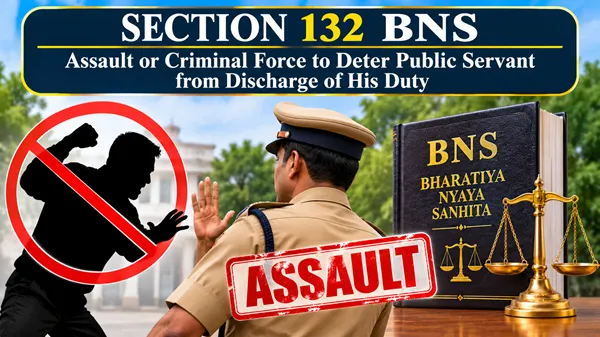
What is Section 132 BNS?
Assault or criminal force to deter public servant from discharge of his duty.— Whoever assaults or uses criminal force to any person being a public servant in the execution of his duty as such public servant, or with intent to prevent or deter that person from discharging his duty as such public servant, or in consequence of anything done or attempted to be done by such person in the lawful discharge of his duty as such public servant, shall be punished with imprisonment of either description for a term which may extend to two years, or with fine, or with both.
Is Section 132 BNS Is Bailable or Non-Bailable?
Section 132 BNS is a non-bailable offence. This means that the accused cannot claim bail as a matter of right and must apply to the court for bail. The court has the power to grant or reject bail depending on the facts and circumstances of the case. Therefore, Section 132 BNS is non-bailable, but the accused can still get bail with the permission of the court.
Read: Section 112 BNS: Petty Organised Crime & Punishment
What is Section 132 BNS Punishment?
The punishment under Section 132 BNS is imprisonment for a term of up to 2 years or fine or both. The court decides the punishment based on the facts of the case, seriousness of the offence, evidence and circumstances involved.
Is Section 132 BNS Cognizable or Non-Cognizable?
Section 132 BNS is a cognizable offence. This means that the police have the power to register an FIR and investigate the case without obtaining prior permission from the Magistrate. The police can also arrest the accused without a warrant, subject to the applicable legal provisions.
Is Section 132 BNS Compoundable or Non-Compoundable?
Section 132 BNS is a non-compoundable offence. This means that the accused person and the victim cannot settle the matter between themselves and close the criminal case through a mutual agreement. Even if the victim is willing to forgive the accused or both parties reach a compromise, the offence cannot be officially compounded under Section 359 BNSS because Section 132 BNS is not included in the list of compoundable offences. Therefore, the criminal case will continue according to law, and the final decision will be made by the court.
Section 132 BNS Is Triable By Which Court?
Section 132 BNS is triable by Any Magistrate Court. This means that cases registered under Section 132 BNS can be heard and decided by a Magistrate Court.
What is the equivalent of Section 132 BNS under the Indian Penal Code (IPC)?
Section 132 BNS, deals with assault or criminal force to deter public servant from discharge of his duty, corresponding to Section 353 IPC. Section 132 BNS applies to offences committed on or after 1 July 2024.
Essential Elements of Section 132 BNS
To establish an offence under Section 132 BNS, the prosecution must satisfy the following core legal ingredients:
- Public Servant: The person against whom the assault or criminal force is used must be a public servant who is performing their official duties.
- Assault or Criminal Force: There must be an assault or use of criminal force against the public servant. Mere words or disagreement are not sufficient unless they amount to assault under the law.
- While Performing Official Duty: The public servant must be performing their official duty at the time of the incident.
- Intention to Prevent or Deter: The act must be done with the intention of preventing or stopping the public servant from performing their official duty.
- In Response to Official Acts: The assault or criminal force may also be used because of something already done or attempted by the public servant while lawfully performing their official duty.
Also Read: Section 35 BNS: Right of Private Defence of Body & Property
Practical Examples of Section 132 BNS
- Assault on a Police Officer During Arrest: If a police officer is lawfully arresting a person and the accused punches, pushes or kicks the police officer to prevent the arrest, such an act may attract Section 132 of the BNS. This is because the accused has used criminal force against a public servant to stop them from performing their official duty.
- Attack on a Traffic Police Officer: If a traffic police officer stops a vehicle for violating traffic rules and the driver becomes angry and slaps or pushes the officer to avoid legal action, the driver may be held liable under Section 132 BNS. The use of criminal force is connected with preventing the officer from performing their official duty.
- Obstructing a Government Officer During Inspection: If a government officer visits a shop or factory to conduct a lawful inspection and the owner physically pushes or attacks the officer to stop the inspection, the owner may be charged under Section 132 BNS. This is because the accused has used criminal force to prevent the officer from carrying out their official responsibilities.