
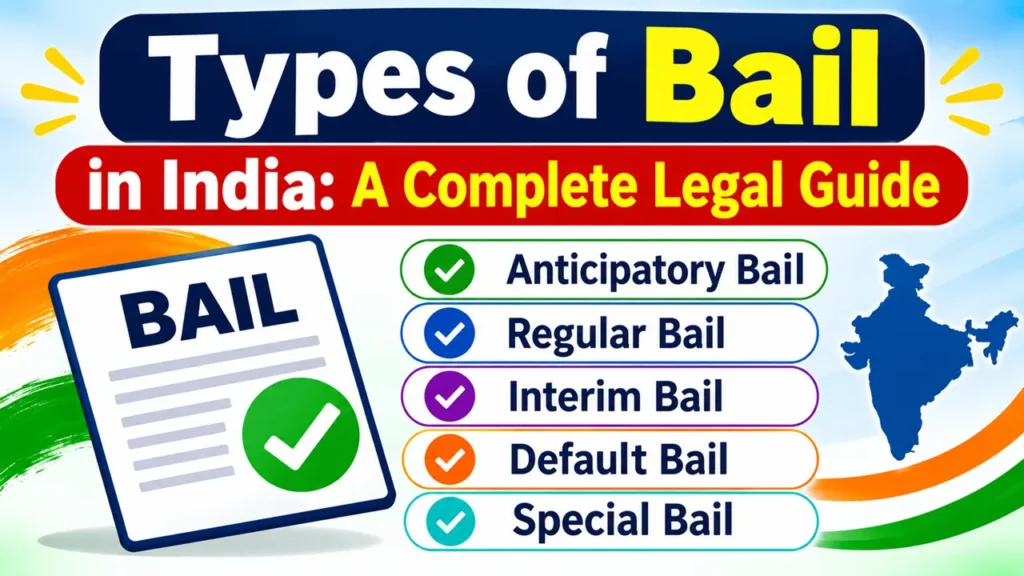
Being accused of a criminal offence can be a painful experience, especially when it involves arrest or the possibility of being taken into police custody. In such situations, understanding the different types of bail in India becomes extremely important.
Bail is a legal provision that allows an accused person to remain free from custody, subject to certain conditions, while the investigation or trial continues. It protects an individual’s personal liberty while ensuring that they remain available for investigation and court proceedings.
Indian criminal law recognises different forms of bail depending on the circumstances of the case, the nature of the offence, and the stage of criminal proceedings.
With the introduction of the Bharatiya Nagarik Suraksha Sanhita (BNSS), 2023, which came into effect on 1 July 2024, provisions relating to bail are now governed by the new criminal procedure law.
What Is Bail in India?
Bail refers to the conditional release of an individual accused of committing a criminal offence from police or judicial custody.
When a person is arrested, they may approach the appropriate authority or court for release on bail, depending on the nature of the offence and applicable legal provisions.
Bail generally involves furnishing a bail bond, with or without sureties, and agreeing to comply with conditions imposed by the court.
The primary objectives of bail are:
- To protect an individual’s right to personal liberty.
- To ensure that the accused appears before the court whenever required.
- To prevent unnecessary detention before conviction.
- To ensure that the accused does not tamper with evidence or influence witnesses.
- To maintain a balance between individual rights and the interests of justice.
It is important to understand that granting bail does not mean that the accused has been declared innocent. The criminal proceedings continue according to law.
Types of Bail in India
There are several commonly recognised forms of bail in India. The appropriate type depends on whether the individual has already been arrested, anticipates arrest, or has remained in custody beyond the legally prescribed period.
The major types of bail in India include:
- Regular Bail
- Anticipatory Bail
- Interim Bail
- Default Bail (Statutory Bail)
- Transit Anticipatory Bail
- Bail on the Ground of Prolonged Undertrial Detention
1. Regular Bail
Regular bail is one of the most common types of bail in India. It is granted to a person who has already been arrested and is currently in police custody or judicial custody. An accused person can apply for regular bail before the appropriate court after arrest.
The court considers several factors before granting bail, including:
- The seriousness and nature of the alleged offence.
- The possibility of the accused fleeing from justice.
- The likelihood of evidence being tampered with.
- The possibility of influencing or threatening witnesses.
- The accused person’s criminal history.
- The circumstances and facts of the particular case.
2. Anticipatory Bail
Anticipatory bail is a form of pre-arrest protection available to a person who has reason to believe that they may be arrested in connection with a non-bailable offence. Unlike regular bail, anticipatory bail is sought before the actual arrest takes place.
It allows an individual to approach the Court of Session or High Court and request a direction that they be released on bail if arrested in the relevant case.
Important: Anticipatory bail is not an automatic right in every case. The court examines the facts, allegations, and applicable statutory restrictions before granting relief.
3. Interim Bail
Interim bail refers to temporary bail granted by a court for a limited period or until a particular stage of proceedings. The purpose of interim bail is to provide temporary protection from custody until the court makes a final decision on the main bail application.
Interim bail may be considered in circumstances such as:
- When the court needs additional time to examine the bail application.
- When the prosecution requires time to submit its response.
- When temporary protection is considered necessary in the interests of justice.
- When the court considers specific urgent circumstances sufficient to justify temporary release.
4. Default Bail (Statutory Bail)
Default bail, also known as statutory bail, is a legal right available to an accused person when the investigating agency fails to complete the investigation and submit the required police report within the prescribed statutory period, while the accused remains in custody. This provision protects individuals from indefinite detention during an investigation. Under the Bharatiya Nagarik Suraksha Sanhita, 2023, the relevant provision is Section 187(3).
The general statutory investigation periods are:
- 90 days: For offences punishable with death, imprisonment for life, or imprisonment for a term of ten years or more.
- 60 days: For other offences.
If the investigation is not completed and the police report is not filed within the applicable period, the accused may become entitled to default bail, provided the statutory requirements are satisfied.
Example:
Suppose a person is arrested in a case for which the applicable investigation period is 60 days. If the investigating agency fails to file the required police report within that period, the accused may apply for default bail after satisfying the legal requirements.
5. Transit Anticipatory Bail
Transit anticipatory bail is a form of temporary pre-arrest protection that may be granted when a person apprehends arrest in a criminal case registered in a different state or territorial jurisdiction.
It is particularly relevant when the individual needs protection long enough to approach the court that ordinarily has jurisdiction over the criminal case.
For example, a person residing in Bengaluru may apprehend arrest in a criminal case registered in Delhi. They may approach the appropriate court in Karnataka seeking limited transit anticipatory protection. The purpose is to protect personal liberty and provide reasonable time to approach the competent court.
Legal position:
Transit anticipatory bail is not expressly provided as a separate category under a dedicated section of the BNSS. However, the Supreme Court has recognised the concept in its judgment in Priya Indoria v. State of Karnataka (2023).
The Supreme Court explained that a court outside the territorial jurisdiction of the investigating court may grant limited transit anticipatory bail in appropriate circumstances, subject to safeguards and conditions.
Important: Transit anticipatory bail is generally limited in duration and does not replace the requirement to seek appropriate relief from the competent court.
6. Bail on the Ground of Prolonged Undertrial Detention
Prolonged undertrial detention refers to a situation where an accused person has remained in custody for a substantial portion of the maximum imprisonment prescribed for the alleged offence without the conclusion of the investigation, inquiry, or trial.
Section 479 of the Bharatiya Nagarik Suraksha Sanhita, 2023, deals with the maximum period for which an undertrial prisoner can be detained.
Broadly, the provision provides:
- An undertrial prisoner may be entitled to release on bail after undergoing detention up to one-half of the maximum imprisonment prescribed for the offence.
- A first-time offender who has never been convicted may be entitled to release on bond after undergoing detention up to one-third of the maximum imprisonment prescribed for the offence.
However, this provision contains important qualifications and exclusions. For example, it does not apply to offences for which death or life imprisonment is specified as a punishment, and it restricts release where investigations, inquiries, or trials involving multiple offences or cases are pending.
The court must examine the statutory conditions before ordering release. This provision is intended to protect undertrial prisoners from unnecessarily prolonged detention.
Difference Between the Types of Bail in India
Understanding the difference between various types of bail can help individuals identify the appropriate legal remedy.
| Type of Bail | When It Is Applicable | Relevant Provision |
|---|---|---|
| Regular Bail | After arrest | Sections 480 and 483, BNSS |
| Anticipatory Bail | Before arrest | Section 482, BNSS |
| Interim Bail | Temporary relief during pending proceedings | No separate dedicated section |
| Default Bail | Failure to complete investigation within the prescribed period | Section 187(3), BNSS |
| Transit Anticipatory Bail | Temporary pre-arrest protection to approach the competent court | Recognised judicial relief; linked to Section 482 |
| Prolonged Undertrial Detention | After the prescribed portion of the maximum detention period | Section 479, BNSS |
What Factors Does a Court Consider Before Granting Bail in India?
A court does not grant bail automatically in every criminal case. It evaluates the circumstances and legal requirements before deciding whether an accused person should be released.
Some important considerations include:
- Nature of the offence: The seriousness of the alleged offence and the punishment prescribed under law.
- Evidence available: The material collected during the investigation and its relevance to the allegations.
- Risk of absconding: Whether the accused is likely to avoid court proceedings.
- Possibility of evidence tampering: Whether the accused may interfere with evidence or influence witnesses.
- Criminal antecedents: Whether the accused has previous criminal convictions or pending cases.
- Personal circumstances: Relevant factors such as age, health, and other circumstances recognised by law.
- Investigation requirements: Whether custodial interrogation or further investigation is necessary.
- Applicable statutory restrictions: Whether any special legislation imposes additional conditions for granting bail.
The final decision depends on the facts of the individual case and the applicable law.
What Is the Procedure for Applying for Bail in India?
The procedure for obtaining bail depends on the type of bail being requested and the stage of the criminal proceedings.
Generally, the process involves the following steps:
Step 1: Consult a Criminal Lawyer
The first step is to consult a qualified criminal lawyer who can examine the allegations, FIR, applicable legal provisions, and circumstances of the case.
Step 2: Identify the Appropriate Type of Bail
Based on the circumstances, the lawyer determines whether regular bail, anticipatory bail, default bail, or another form of relief is appropriate.
Step 3: Prepare the Bail Application
The bail application is prepared with relevant facts, legal grounds, supporting documents, and applicable statutory provisions.
Step 4: File the Application Before the Appropriate Court
The application is submitted before the court having jurisdiction and the relevant powers to consider the requested relief.
Step 5: Attend the Bail Hearing
The court hears the submissions of the applicant and prosecution before deciding the application, subject to applicable procedural requirements.
Step 6: Comply With Bail Conditions
If bail is granted, the accused must fulfil the bond and surety requirements, if any, and comply with all conditions imposed by the court.
Step 7: Complete Release Formalities
After the necessary bond and release documentation are processed, the release order is implemented by the relevant authorities.
What Are the Conditions Imposed While Granting Bail?
Courts may impose different conditions depending on the facts of the case and the nature of the offence.
Common bail conditions include:
- Attending court hearings whenever required.
- Cooperating with the investigating agency.
- Not influencing or threatening witnesses.
- Not tampering with evidence.
- Not committing similar offences.
- Not leaving India without prior permission, where such a condition is imposed.
- Providing a valid address and contact details.
- Furnishing a bail bond and sureties, where required.
- Make themselves available for interrogation when required.
Failure to comply with bail conditions may result in cancellation of bail and other legal consequences.
Can Bail Be Cancelled in India?
Yes. Bail can be cancelled by a competent court in appropriate circumstances.
For example, bail may be cancelled if the accused:
- Violates the conditions imposed by the court.
- Attempts to influence or threaten witnesses.
- Tampers with evidence.
- Misuses the liberty granted through bail.
- Commits another offence or otherwise obstructs the administration of justice.
Section 483(3) of the BNSS empowers the High Court or Court of Session to direct the arrest and commitment to custody of a person released on bail under the relevant chapter.
Frequently Asked Questions (FAQs) About Types of Bail in India
1. How many types of bail are there in India?
There is no single statutory list that classifies every form of bail into a fixed number. Commonly discussed forms include regular bail, anticipatory bail, interim bail, default bail, transit anticipatory bail, and release based on prolonged undertrial detention.
2. Which section deals with anticipatory bail in India?
Section 482 of the Bharatiya Nagarik Suraksha Sanhita, 2023, deals with anticipatory bail. It allows a person apprehending arrest for a non-bailable offence to approach the High Court or Court of Session.
3. Which section deals with regular bail under BNSS?
Sections 480 and 483 of the BNSS are important provisions governing regular bail in non-bailable cases and the special bail powers of the High Court and Court of Session. Section 478 deals with bail in bailable cases.
4. What is the difference between regular bail and anticipatory bail?
Regular bail is generally sought after a person has been arrested and is in custody. Anticipatory bail is sought before arrest when an individual apprehends arrest in connection with a non-bailable offence.
5. What is default bail in India?
Default bail is a statutory right that may arise when the investigating agency fails to complete the investigation and file the prescribed police report within the applicable statutory period. Section 187(3) of the BNSS governs this provision.
6. Is anticipatory bail available for every offence?
No. Anticipatory bail is not available without restrictions in every case. Certain special laws impose restrictions, and Section 482(4) of the BNSS excludes specified offences under the Bharatiya Nyaya Sanhita from its application.
7. Can bail be granted in a non-bailable offence?
Yes. Bail can be granted in non-bailable offences depending on the facts, applicable legal provisions, and judicial discretion. However, certain offences are subject to stricter statutory restrictions.
8. Is bail a fundamental right in India?
The right to personal liberty is protected under Article 21 of the Constitution of India. Bail plays an important role in protecting personal liberty, although bail itself is governed by statutory provisions and judicial principles rather than being an unconditional right in every case.
9. What happens if a person violates bail conditions?
The court may cancel bail and direct the accused to be taken into custody. The consequences depend on the nature of the violation and applicable law.
10. Can a person apply for bail more than once?
Yes. A person may file a subsequent bail application in appropriate circumstances, particularly when there is a material change in circumstances or new grounds arise. However, repeated applications without a genuine change in circumstances may not be entertained favourably.
Conclusion
Understanding the different types of bail in India is essential for anyone dealing with criminal proceedings. Whether it is regular bail after arrest, anticipatory bail before arrest, interim bail for temporary protection, or default bail due to an incomplete investigation, each form of bail serves a specific legal purpose.
The Bharatiya Nagarik Suraksha Sanhita, 2023, has introduced the current statutory framework governing bail and criminal procedure in India, replacing the earlier Code of Criminal Procedure, 1973, with effect from 1 July 2024.
Since bail decisions depend on the nature of the offence, evidence, individual circumstances, and applicable legal restrictions, obtaining appropriate legal advice is important before filing a bail application.